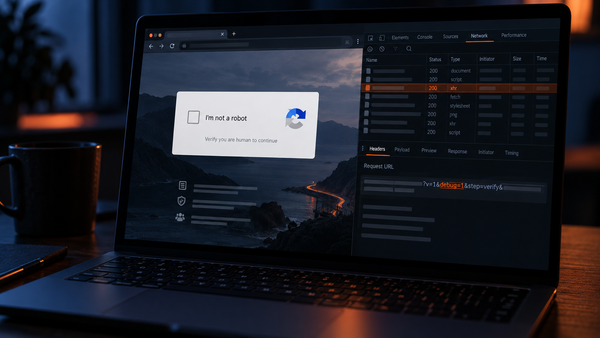
The WooCommerce Attack Every Security Executive Should Pay Attention To

A recent WooCommerce attack, analysed by Scott Helme, Report URI's CEO, exposed something many organisations are still struggling to fully grasp:
Your website can be actively stealing customer payment data while appearing to function completely normally.
No outage.
No ransomware.
No obvious breach.
No backend compromise alerts.
Customers continued browsing, adding products to cart, and completing purchases as normal.
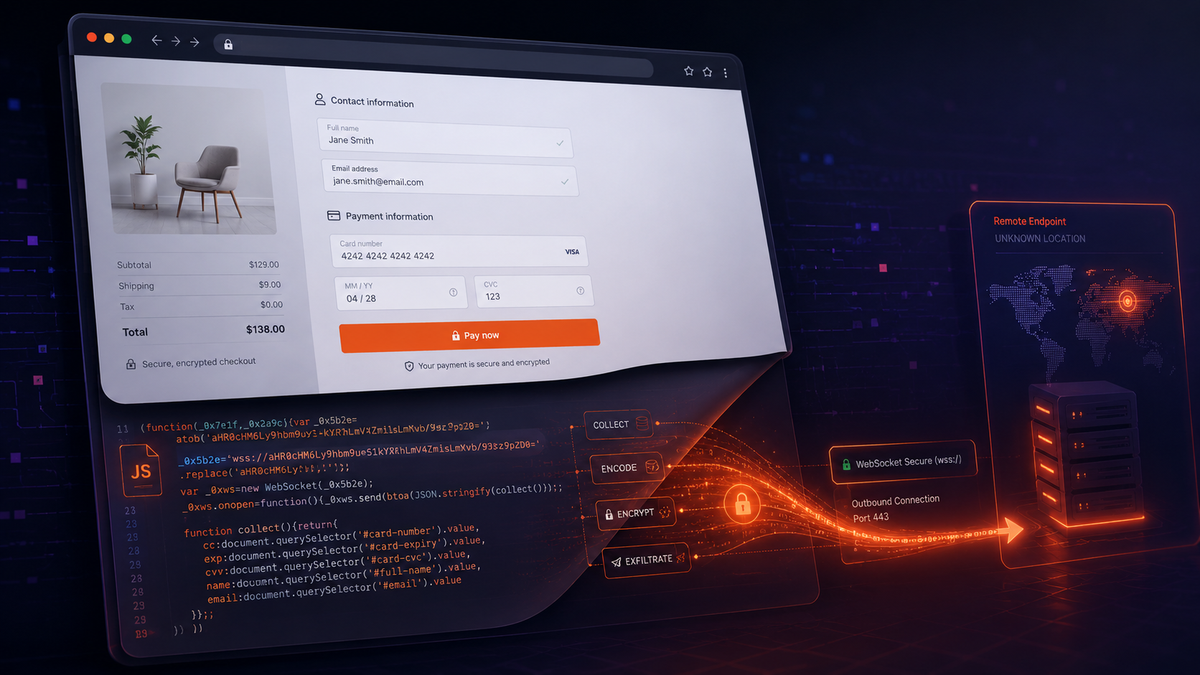
Meanwhile, malicious JavaScript embedded inside a legitimate website asset was silently capturing payment card details, personal information, addresses, phone numbers, and browser data directly inside the user’s browser.
The attack was specifically designed to avoid detection.
That should concern every security leader.
What actually happened
The attackers modified an existing JavaScript file already trusted by the website. Rather than breaking functionality or introducing obvious malicious behaviour, they inserted carefully obfuscated skimming code into a legitimate asset.
The site continued working normally.
Behind the scenes, the malware:
- monitored checkout fields in real time
- validated card numbers before theft
- captured customer identity information
- encrypted the stolen data
- exfiltrated it over secure WebSocket connections
- and actively attempted to evade detection
This was not noisy, opportunistic malware.
It was engineered for persistence, stealth, and reliability.
Most importantly, the attack targeted the browser because that is where the valuable data existed.
The attackers did not need backend access to payment systems. They simply needed code execution inside the customer’s browser session.
The executive lesson most organisations are missing
For years, security programmes have largely focused on protecting infrastructure.
But this attack demonstrates a major shift in how modern compromises happen.
The organisation’s servers may remain secure. Cloud environments may remain uncompromised. Identity systems may remain untouched.
Yet customer data can still be stolen at scale directly from the website experience itself.
That changes the conversation significantly for CISOs and security leaders.
The uncomfortable reality is that many organisations have very limited visibility into:
- what code is executing in users’ browsers
- when that code changes
- whether those changes are authorised
- what external connections are being made
- and what data is leaving the browser
In many environments, nobody is continuously monitoring this layer at all.
Why attacks like this are difficult to detect
This is what makes client-side attacks particularly dangerous from a governance and risk perspective.
Traditional controls often fail because:
- infrastructure monitoring sees normal traffic
- endpoint tooling never triggers
- the website remains operational
- the customer journey appears unaffected
- and the compromise exists entirely inside the browser
To a security operations team, everything can appear healthy.
Meanwhile, attackers may already be harvesting payment and customer data in real time.
In many cases, organisations only discover these attacks weeks or months later through:
- fraud investigations
- payment provider notifications
- chargebacks
- regulatory investigations
- customer complaints
- or forensic reviews after a breach disclosure
At that point, the reputational and regulatory damage is already unfolding.
This is no longer just a PCI DSS problem
Attacks like this are often discussed through the lens of PCI DSS compliance because payment data is involved.
But the broader lesson is much bigger.
Modern websites increasingly execute large volumes of third-party and dynamically changing code. Marketing platforms, analytics tools, tag managers, customer support integrations, optimisation tools, and supply chain dependencies all introduce execution paths directly inside users’ browsers.
For attackers, this creates an attractive opportunity: compromise the browser environment rather than the infrastructure behind it.
The browser has effectively become part of the enterprise attack surface.
Many organisations have not fully adapted their security strategy to reflect that reality.
The strategic takeaway for security leaders
The key question security executives should now be asking is not simply:
“Is our infrastructure secure?”
It is:
“How quickly would we know if malicious code started executing inside our customers’ browsers?”
For many organisations, the honest answer is uncomfortable.
The organisations that adapt fastest to this shift will be those that:
- treat the browser as part of their attack surface
- gain visibility into client-side behaviour
- monitor changes to website code continuously
- and recognise that website compromise no longer requires infrastructure compromise
Because modern attacks increasingly happen in the one place many organisations still struggle to see clearly: the browser itself.